Showing posts with label africa. Show all posts

Thursday, December 31, 2009

It was a very good year

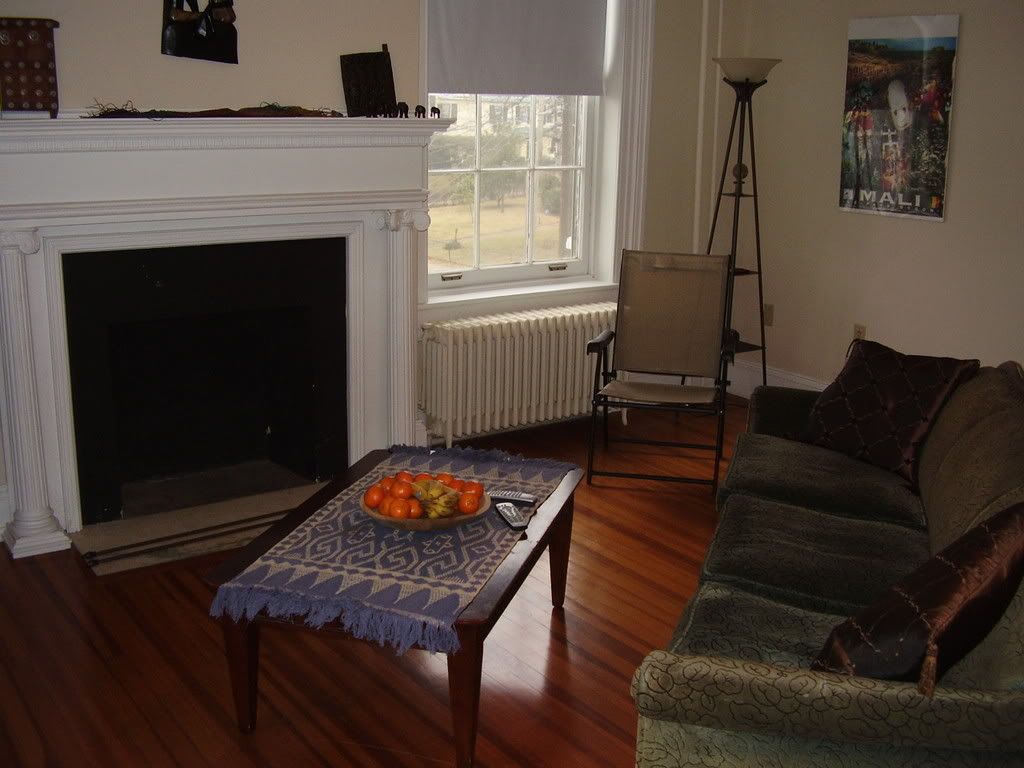
2009 was a busy, eventful and life-changing year over here at chez sula. For starters, the location of "chez" (which literally means at the home of). It was one year ago today that DH and I finished moving all our stuff from the house I was sharing with messy college students into a cozy, historic apartment smack in the old town. We rang in the new year by spending our first night here. And how lovely it has been. Not just to have one's own place, but the location, the architecture, the windows and sunlight, everything. A great way to start 2009.


In April, I led a group of students, faculty and staff from our university on a one-week trip to Mali. Not only was it a great experience to be able to share the country I love with others, but I also got to re-connect with friends back there and visit DH's family. AND get back to speed on my language skillz (which apparently may go dormant but are not lost...happily).

The first half of the year also saw both DH and I busily working on our respective degree programs. It's important to note that in DH's country, there is only one university. When he attended classes there back in the early part of the 2000s, a series of strikes resulted in the entire academic year being canceled. So he ended up working and doing other things and wasn't able to go back and finish his degree. When we got the chance to come to the States and study, it was an unforeseen opportunity. He slogged through three years of classes in not his second, but his THIRD language, was often the oldest student in his courses, and worked a part-time on-campus job to boot. So when he walked across the stage at commencement in May and received his bachelor's degree (the first person in his family to do so) I was bursting-at-the-seams-proud. :)

Right after graduation, there was another trip out of the country for me...I was in Taiwan for about 10 days for my work. It was special in that I got to spend time with a colleague and friend who is from there and being with her gave me lots of insider scoops that I wouldn't have had otherwise. (Did I mention the all-u-can-eat sushi bar for under $10????) heh. But I missed my fiance and it was nice to come home again.
After two long years of part-time evening classes with no breaks for summer, I too got a chance to walk across the stage in August and receive my MBA. (Come to think of it, I guess I'm the first person in my family to get a graduate degree.) It was nice to finish the program, and I barely had time to catch my breath before my 30th birthday. Yet another mile-stone of sorts. heh.

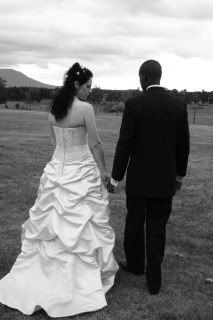
Then it was full speed ahead to the biggest milestone of our lives...our wedding! Thankfully, I had a couple of very talented and giving friends who basically planned, coordinated, decorated and shepherded me through the whole process. The ceremony was held in the backyard of our good friends. The mountains and fields served as a cathedral unmatched in beauty. With a classic English garden at on end, guests were seated in four sections creating a circle which surrounded the ceremony site. Our families began the processional and walked in pairs to their seats in front of the garden. To the strains of a single violin, the wedding party processed through the garden paths and met one another in the center of the ceremony circle. During a moving interfaith ceremony led by our two ministers (husband and wife), we took our vows and exchanged rings. A djembe drum ensemble led the celebration as we left the circle as husband and wife.

Our reception was held under the trees in an open buffet style. Among the dishes served were roast lamb, plantains and a special African rice dish. After toasts by the best man and matron of honor, we enjoyed musical selections by a small gamelan orchestra, an instrument native to Indonesia (my childhood home). We cut the cake and then had our first dance to a song by a musician from DH's home country. Guests joined in the dance and much fun and laughter was had. Before the sun set, we changed into our best traditional African clothing and finished the evening by spending time talking with our friends and family.
As if that weren't enough for an eventful 2009, DH found a great job (in this economy no less) and started work shortly after our wedding. I began taking Spanish classes and applied to another graduate program for spring (hey, gotta keep busy). Then last week, we traveled down to Louisiana to spend Christmas with my parents and meet my mom's side of the family. I hadn't seen my grandparents, aunts, uncles, cousins, etc. since 2000...so it was quite fun to catch up with everyone and to introduce DH.

whew! Now that I look back on all that, I can sort of see why my blog has fallen by the wayside. Hopefully next year I can get back to reading more books and writing more entries. So that was 2009. This is a year I don't think I'll ever forget. Now onward to 2010!

Happy New Year to everyone who takes the time to stop by this little corner of the interwebs. :)

Tuesday, March 17, 2009

Out of Africa

Hello friends! I am back from my trip as of monday evening and although I'm swamped with overdue work and homework, I wanted to throw up some pictures. Here's a few from my very very busy and incredibly awesome trip.


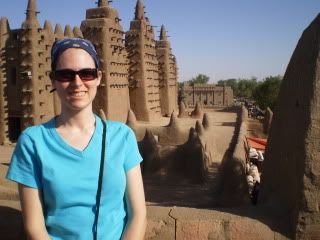
Famous mud mosque of Djenne (UNESCO world heritage site)


The morning view from my mat on the roof where I slept the first night we trekked in Dogon Country.


Dogon village where we spent another night on the roof (if you look to the right just above center, you can see the campement with the mats on part of the roof).


Chief of the village where we visited a Peace Corps volunteer for a day.


Yes, termite mounds can really get that big (and even bigger!)


Sunset on the Bani River in the port city of Mopti.


Regular traffic scene in the bustling capital city of Bamako, my home for two years. The locals have taken to calling it Obamako. *g*


My adorable goddaughter and my future sister-in-law. :-)

Wednesday, March 4, 2009

africa here i come!

As I mentioned earlier, I'm off to Africa on Friday. Will be leading a group of 10 people on a 10-day trip to my old stomping grounds. Of course I'm terribly excited but also apprehensive at being in charge of everything. Lots of details and a jam-packed itinerary. But it will be great to be back there, to visit all of the sights and to give lots of gifts to DFs family. :)

Here are some pics to give you an idea of where I'll be...

We'll be trekking up in this area for two days and nights. It's rugged and beautiful and totally fascinating. The villages we will visit are places I have been to before. I think the hikes are doable by everyone in the group. Hey, if I can do it, anyone can. I'm soooo not physically fit. lol. Of course, temperatures are in the 100s now, so we'll be taking it slow (and staying put during midday).

Crazy fun at the open market in the capital city. This was my view every day going to and from work. Total chaos. But it all works out in the end.


mmm, I hope I get to eat some of my favorite dishes. Groundnut stew, riz au gras, and good ol' rice and sauce. Fried plaintains too. Oh yeah.

So I'm not sure if I'll get a chance to blog between now and Friday, but I'll certainly have some stories to share in a week or so. K'an b'en sooni!

Friday, February 29, 2008

More stories from Africa

Apparently, I'm not destined to blog about books this week. In fact, it is national Peace Corps Week, so it's appropriate, I guess, that I'm thinking about my experiences in Africa and sharing them. You all will have to put up with another lengthy ramble from my journal...this time it is from my first month as a volunteer. To set the stage - I had finished my two-month in-country training period and been stationed in the capital city. It just so happened that I started my work during the month of Ramadan, and I decided to participate in the fast so that I could get a better feel for what life was really like in my new community. So here goes...

A Day in the Life

My alarm clock begins beeping at 4:15. Crickets chirp outside my darkened windows and I can hear the murmur of voices in the courtyard outside my living room window. If I ignore the alarm and fail to awaken, inevitably in a few minutes there will be a rapping on the window and someone will call my name. “Koumba, Koumba!” I swing out of bed, slip on some sandals, wrap a sarong around my waist and stumble out the door. “Aw ni sogoma” (Good morning) I croak. Four or five men sit huddled around a common bowl, scooping rice and sauce into their mouths with the right hand. “Nba, I ni sogoma,” they respond. A woman sits beside a coal brazier, stirring a large pot of hot milk. I pull up a chair and someone hands me a plate of rice. After rinsing my hands in a bowl of water, I mix the sauce into the rice with my fingers. When it cools enough to touch, I use my hand to make a sort of a spoon and begin to eat. In another part of the courtyard, children gather around other bowls, quietly eating. It’s dark; somewhere in another part of the neighborhood the muzzein is reciting parts of the Koran. Mosquitos nip at my ankles. Sulieman turns on a small radio and the familiar Parisian intonations of the ubiquitous Radio France newscast flow over my ears. Each day I find I understand and can follow the rapid text more and more, if I care to pay attention.

I can never even eat half of the rice that is heaped on my plate, so whenever I feel like stopping I put the plate down and motion for the bowl of water to wash off my hand. The man next to me hands me a cup of hot, sweetened milk with a hunk of baguette balanced atop it. I chew the bread sleepily and drink the milk to wash it all down. I try to listen to the muted conversation of the people around me which is inevitably in Bambara with a few French conjunctions thrown in here and there. Between trying to decipher the French on the radio and the Bambara spoken around me, I’m quiet and don’t attempt to add much to the dialogue unless asked a question. At which point I respond in the best Bambara I can muster, resorting to French words to fill in gaps in my vocabulary. When I finish with the bread and milk, I thank them for the food and then go back into my house to crash into bed. It’s still quite dark outside and the mosque lulls me back to sleep.

After a few more hours of sleep and several rounds of hitting the snooze on my alarm, I shake myself awake around 7:30 or 8:00. I’m expected to show up at work sometime around 9, but no one is keeping track. I fill up a bucket with cold water and use a dipper to pour the water over me. My tiny bathroom actually has a shower but it never has enough water pressure in the morning to sustain more than a few pathetic drips. After choosing an outfit and dressing myself in Malian clothing, I tie a matching strip of cloth around my head and arrange the excess cloth so that it drapes casually around my face. I slip on my dress sandals, check to make sure everything I need is in my goatskin leather purse and head out the door to greet whomever is around. You and the morning, was the night peaceful, how is your family, may we have peace in the day, may Allah bless us during this month of Ramadan - are just a few of the things we will say to each other.

Finally out the gate of my concession I stride down the street to catch the little green Peugot truck that is my public transportation into the center of the city. As I pass clumps of people, women selling bananas, children playing, men sitting in the shade I nod and sometimes greet them. It takes about ten minutes to reach the place where I will pick up my ride and I have to dodge motorcycles, cars, trucks, bikes, and pedestrians in order to cross the street. The green pick-up swings around the corner and the man in the back jumps out to usher passengers aboard. I climb into the vehicle, ducking my head to avoid hitting it on the low roof, take a seat on one of the benches and say good morning to the other passengers. Occasionally they will want to chat a bit, but usually everyone is lost in their own thoughts during the ride. The boy bangs on the side of the truck, running alongside and swinging himself into the back as the driver puts it in gear and we begin to roll into traffic. The same pattern is repeated at each scheduled stop. We reach the hectic street of the market and the road is clogged with green vehicles, all ferrying people to and fro. I hand my coin to the boy and tell him which stop I need to get off at. As we reach it, he bangs on the side of the vehicle and the driver pulls over. I get out and say goodbye, heading down the street to one of my two different offices. If it’s Monday or Tuesday I will have another ten to fifteen minute walk to OMATHO. If it’s Wednesday or Thursday, it’s only five minutes down a different street to CNPA.

As I walk down the busy streets, beggars call for my attention. Polio victims with shriveled limbs, old blind women, young women with armfuls of children. I haven’t yet figured out how to respond to every case. Sometimes I drop a coin into their buckets, but most of the time I pass them by. It’s a helpless feeling and one that I doubt I’ll ever get used to. As I pass stalls and shops, people call out to me in Bambara “hey, white woman, your clothes are beautiful” or “your braids are lovely” or “you look like an African.” I smile and say thanks as I continue on my way. Every once in a while a persistent admirer will walk alongside me trying to engage me in French conversation. I try to be polite but continue walking and tell him that I’m busy. I actually think that I may get myself a ring to wear and tell these sorts that I’m married and that my husband doesn’t like me talking to strange men. But so far, I’ve managed.

I get to my office and greet the guards and whomever is hanging out in the gateway. We joke around and they tell me how much I’m becoming like an African. I tell them that I couldn’t possibly be Malian because I can’t speak Bambara very well yet. Well, that will come “dooni dooni” they say. Little by little. Yes, I reply, Insh’Allah. If God wills it.

Entering the office, I make the rounds of greetings with all who are there and spend time chatting with the secretaries. Usually this is a melange of my very clumsy Bambara mixed with my much better French. If the person I am supposed to meet with is in a meeting, I may spend the entire morning just hanging out and talking while I wait. So far, although this grates a bit against my American sense of being lazy and useless, here it’s considered very important to build strong social relationships with your coworkers. So I tell myself that and enjoy the time chatting. The reception area at OMATHO always has some tour guides coming in and out, so I talk to them about their jobs, try to learn some of their languages. I can already do the greetings in Sonhrai, the language spoken farther east and north in places like Timbuktu and Gao. I’m trying to learn a few phrases in Dogon, the language of the people group of the same name who live along a long escarpment of cliffs and still practice much of their ancient traditions. Dogon Country is one of the main tourist draws Mali has to offer. I can’t wait to get my chance to go trekking there.

Because it’s the month of Karem and people are fasting, what would be lunch time comes and goes. Not everyone fasts, so there are people going out to buy street food and they take a bit of teasing from those of us who are fasting. Every time I am offered food and refuse, saying that I’m fasting, there is shock and usually amusement. Then expressions of approval and sometimes questions as to whether or not I pray. Yes, I say, I do pray but I’m not Muslim. I pray in the Christian manner. Oh, they respond. You mean like this? While they make the sign of the cross. Not exactly, I explain, I’m not Catholic, I’m Protestant. How do you pray? They ask. Anytime, anywhere, I respond. Ahhh. They look amused and curious. They tell me I should come to prayers with them sometime. I say we will have to wait and see. Then we all laugh and move onto another subject.

When I finally get to meet with whomever I’m assigned to that day, we speak French and he or she explains what their part of the office is responsible for. I try to ask questions so as to better understand. The other day at CNPA, I asked if someone could take me down the street to the Maison des Artisans where all the artisans work and sell their crafts. We went there and I was given an informal tour of the place. It’s essentially a big market and workshop. Leather being stretched and cut into sandals and bags, wood being carved into masks and figurines, beads being strung, cloth being woven, silver being heated and hammered into jewelry. I think I would like to buy one of everything, it’s all so lovely and interesting. I can’t wait to start buying items piece by piece to decorate my house. I met with the president of the maison, himself a jeweler and he was very enthusiastic and happy to learn that a volunteer was being assigned specifically to help in the artisan sector. He wants me to come back next week to spend some time getting to know people there and talking about projects we might undertake.

By two or three o’clock things at the office are slow and I usually take my leave. I catch the same truck from the morning, on a different leg of it’s route and get off near the Peace Corps office. Sometimes I come into the office to check my mail, see if a computer is free to check email, or just to talk with the staff. Then I walk to my tutor’s house for my language lesson. We sit outside in the courtyard under the trees and talk. I try to recount my day using whichever language we are focusing on that day. If it’s Bambara, the explanations are brief and straightforward. In French, I am working on getting more nuances and verb forms to flesh out my conversations as I am already proficient enough in simple discussions. Abdoulaye pulls a blackboard against the wall of the house and writes examples in chalk as I ask questions. As people come in and out of the courtyard, we greet them and sometimes talk with them for a bit. Practical application of language, after all. We stop at four o’clock briefly so he can pray. Then continue till around five.

At this point, we are both ready for six o’clock to come and the fast to be broken. Often, we will go out to the store around the corner and buy juice and yogurt, preparing for the call from the mosque that signals the end of the day’s fast. As soon as it the call begins we start by eating dates. I remember that I have always liked dates, but for some reason at the end of a day of fasting they seem to taste better than any food I have ever eaten. We drink steaming bowls of an herbal infusion like tea. It’s amazingly thirst-quenching and is apparently very medicinal and good for you, as well as tasting really good. Other members of the household come out to break fast with us and we all tell each other “I ni baara ji” which literally means “you and your work” but is often used when someone has done a good job at something. After the dates, the tea, the yogurt and the fruit juice, I feel sleepy and content. We usually all sit around rather quietly and reflectively, Abdoulaye and his friend smoking as they haven’t been allowed to do so all day. They wash and prepare to pray and I sit and read. After their prayers, we sit and talk and people begin to arrive for the evening’s communal prayer time/Koran recitation. Then the men go onto the porch and the women into the house. I’ve noticed that the men take turns leading the recitation. The melancholy Arabic tones drift past me and I spend the half-hour thinking, reflecting, studying my language notes, and doing a little praying of my own.

Afterwards, we sit around a common bowl and eat supper. Usually by this time I am tired and ready to head back to my house. Since it’s dark outside and my house is about a twenty-five minute walk, Abdoulaye has his friend drive me home or finds me a cab. I arrive at my house and the little shop that faces out into the street is always full of men on the front porch, watching television or drinking tea. “Koumba, you’re back!” they call. Sometimes I take them up on the invitation to join them in sitting and chatting. It’s a good chance for me to practice Bambara. Then I go into the courtyard and greet whoever is there, usually some women and children. I cross the courtyard to my house, unlock the door and go in. I flip on the lights, always aware of how lucky I am to have electricity as most volunteers in this country do not. After changing and slipping into bed, I write in my journal about my day, trying to make notes of whom I spoke to and what their names are so that I can remember them in the future. I study French verbs. I read a bit of a novel until I’m tired enough to sleep and then switch off the light, lulled to sleep by the sound of the oscillating electric fan.


Monday, February 25, 2008

musical memories from Africa

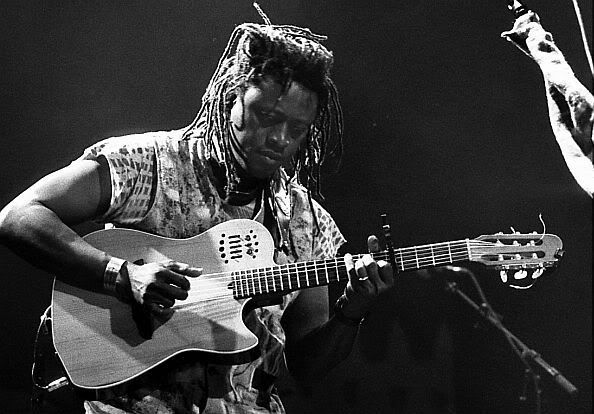
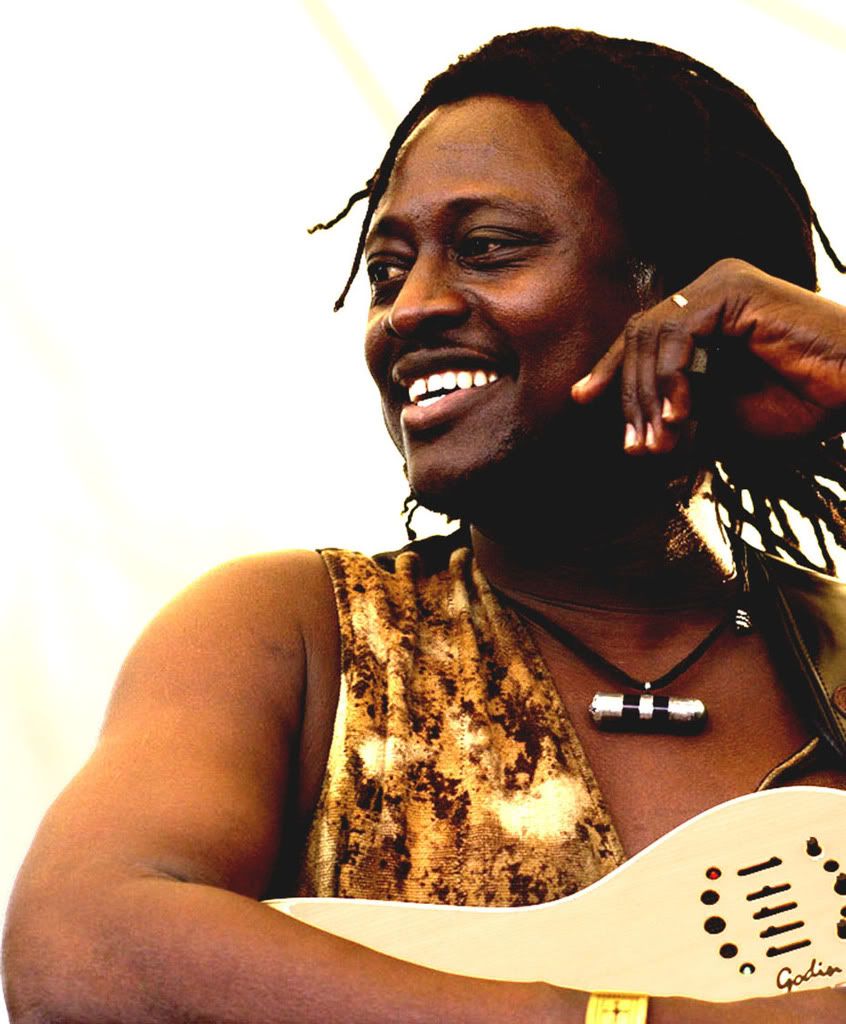
One of the things that I will always take with me from my Peace Corps experience is an expanded musical horizon. I have the best memories of living in Mali and being surrounded by music. From weddings to baptisms, from blaring radios on the roadside to griots bursting out in impromptu song, music is everywhere; it's a part of the culture and the fabric of life. One of the artists that I was lucky enough to not only see perform but also get to know on a somewhat personal level is Habib Koite. Yesterday, I found out that he had released a new album and promptly went out to buy it. As I sit here surrounded by the music, I'm equally surrounded by memories. It prompted me to dig up one of my old journal entries from when I first met Habib in Mali...

...I remember one of the thoughts that crossed my mind when I first learned I was being offered a Peace Corps assignment in Mali. For some reason, I already knew that Mali was known for a rich and vibrant musical tradition. Maybe it was my musician friends whose first reaction to my "I'm going to Mali" announcement was something to the effect of "hey, that's where Ali Farka Toure and Salif Keita are from." Hunting around the Barnes and Noble music section, I found a sample collection of Malian music and I recall playing it in my car as I drove around the Twin Cities in my last months of American life. Intricate guitar melodies evocative of the blues, intertwining rhythms, and the polytonal sound of the balafon, a wooden zylophone that instantly made me homesick for the Indonesian music that was the background of my childhood. All this to say, I couldn't wait to get to Mali and to be able to experience this music in its natural setting, in an interactive way.

So there I was, in Mali and as chance would have it, living in the capital city, the heart of Malian live music. One of my fellow volunteers was very plugged into the local scene. She kept mentioning this guy named Habib. Habib Koite. I'd never heard his music, but according to her, he's one of the best things Mali has to offer at the moment. Which is saying a lot considering the caliber of artists like Salif and Ali Farka. When word goes round that he'll be doing a concert at the French Cultural Center, a group of us get together and decide to go. The FCC is in itself a bit like stepping back into the western world. The small theatre space has a stage, lighting, theatre seating. It's a bit surreal, but nice. A French woman gets up and says a little piece about Habib and his band, introducing them to us and then the lights go down. A tall, dredlocked man walks out with a guitar strapped around his neck and takes his place in front of the microphone. He strikes the strings and begins to play a simple, but achingly beautiful melody. As he continues, he embellishes the notes, and the other band members walk out and take their instruments one by one, adding to the sound as it swirls and builds. I am sold before he even opens his mouth and begins singing in a warm tenor voice. I can't explain, but I suppose it is one of the beautiful things about music, the connection it can make with your soul. I feel deep down that this, this moment, this is one of the things I longed to experience in my Malian journey. The concert continues, I turn to my friend from time to time to get whispered explanations about lyrics, all of which are in Bambara. Habib's fingers fly over the strings of his guitar and I'm amazed at how many stylistic influences he embraces. It's obvious that both he and his band have had some experience with all sorts of music. Hints of Latin flamenco guitar, sliding blues notes, flowing classical scales, rock-like riffs. All seamlessly blended together with modern instruments like a drum kit and bass guitar as well as Malian creations such as the talking drum, the balafon, the djembe and the kora. When it's over, I turn to my friend and tell her that I'm a convert. When's the next show?

Life in Bamako goes on. Our little group of friends ends up going to see Habib and the band play at the Bouna several times. It turns out to be even more fun there as you can get up and move around, unlike the prim and proper setting of the FCC. Dancing our way through many an evening. Before Mali, I was always too shy about how I would look, how I didn't know any proper steps. But more and more I am letting go of my pride and just allowing the music to move me. I stomp my feet, shake my hips and move around and before I know it, I am having the time of my life. It's freeing and I realize more and more that Africa is helping me learn to live life in the moment. It's the night of Habib's last concert in Mali before he leaves to go on tour in the States. We all joke around with each other that we're going to miss coming out to hear the music. But the show is a good one. The band is on, we are all energized. It goes on until two in the morning. By this time, half of the audience has trickled out, tired and heading to their beds. But we stick around and a few of us walk over to say hi to Habib. He knows my fellow volunteer and asks how we are, how was the show, etc. We make small talk until he is called away on some business matter with his manager. Ah well, guess we should go. But suddenly he is done with whatever it was and he asks us where we're going. Do we want to go out to the Tempo? Er, where's that, we ask. Well, you take a right at the roundpoint, then a right, then a left, then...how many of there are you, he asks. We do a quick head count. Nine or ten, we reply. I can take four in my car, he says, and my friend here can probably take five. Let's go!

We all grin at each other. Ok, we're game. A few of us jump in Habib's car and he puts it in gear, smoothly navigating his way through the deserted streets of downtown Bamako. When we arrive at the club, there's not many people there. A man in his forties, in dredlocks, opens my car door and says hi. He looks vaguely familiar, but I can't place him. We all end up in something of an executive suite hang-out room. Habib conducts furniture moving until we have a very comfortable big circle of low couches and chairs. We all take seats, and I end up across from Habib. The other man comes at sits at the end of the circle. A well-coiffed young woman takes our orders for drinks and small conversations spring up all over the table. Habib introduces the man at the end of the table as "a very great Malian musician, this is Omar..." "Koita!" I finish his sentence. Now I remember him! During my time in training, my host dad in village loved this man's music. We used to listen to his tape over and over. (I think to myself how excited my host dad will be when I tell him that I met his musical idol!!)

Habib lights up a cigarette, and I tease him with the words to one of his hit songs "no more cigarette. Abana (It's finished/gone)". He grins and replies that he only smokes on very special occasions, and this wonderful evening of meeting new friends and having a good time is one such occasion. The man definitely knows how to be solicitous and charming. In the corner of the room, two very very drunk Malian men, rich government officials or businessmen by their dress, are carrying on loudly. One of them begins calling "Habib! Habib! Chantes, chantes pour nous." (sing for us) At first Habib just glances over at them, smiles, and tells them that he's tired as he just came from giving a concert, but they continue to call at him. I wonder how long it will take for a bouncer to come escort them out, but Habib gets up and goes over to chat with them. He's courteous and patient, not demeaning. Finally after coming back to sit down with us but still being called upon to sing, he stands up and quiets the room. Then he begins to sing in a clear acapella, presumably making up a song and a tune on the spot. The drunk admirer gazes at him and after the song he begins to cry and sob loudly on the shoulder of his friend, who says loudly in French "see, this is what is so great about Habib. He doesn't forget his roots. He can still do the traditional thing." To which I can only assume he is referring to the griot tradition - the praise singers who are the keepers of the oral traditions. The position is passed down by family and griots are called upon to sing at all major social events in Mali, weddings, funerals, baptisms. Habib's family is griot.

In any case, after this minor entertainment the time passes more conventionally. My friend and I engage Habib in a conversation about his thoughts on development and progress. How does he feel about their effects on Malian culture? I specifically make mention to some of the lyrics in a song he wrote about how this generation is a good one. How they have opportunities to see the world through the medium of television. While my French is pretty good now and I can understand everything he says, I sometimes have a hard time following him. He tends to ramble from one subject, one example, one story to another, and I feel that I can't always thread them together. But essentially, he is both hopeful and cautious. Hopeful in that he sees the possibilities of technology but also cautious in that he fears the loss of his culture, a unique and irreplaceable thing. It's a fascinating conversation and I am sad that we've only started it now at this late hour because everyone is winding down and soon we have to leave. It's five in the morning. A new day is coming. As we say our goodbyes, I tell Habib that I hope his tour in the States will be a good one and promise him that I will email all my friends back there to tell them to go to the shows. He says thanks, and we all pile into cars and cabs to go our separate ways. My Malian musical adventures are only beginning.


...and that was indeed just the beginning.